When the Old Rules No Longer Apply: OHNomad's Jazz Piano Exploration
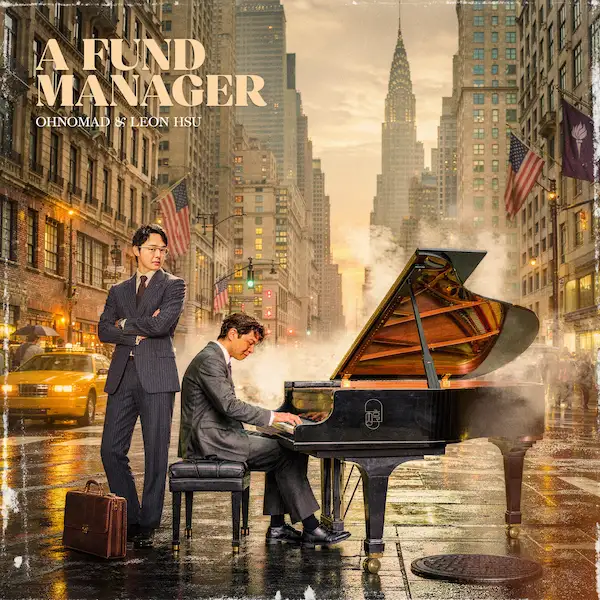
What connects jazz piano, financial markets and independent thinking? Darren Stone explores the ideas behind OHNomad's latest release, A Fund Manager, in this new be musi feature.
Artist: OHNomad
Track: This Time is Different
Style: Jazz / Contemporary Jazz Piano
In this review
About The Artist
Track Spotlight
Curator Notes
Mentor Insight
There is something fascinating about the relationship between music and the way we think. Both can challenge our assumptions, take us somewhere unexpected and occasionally make us question everything we thought we knew. For composer Owens Huang, better known as OHNomad, these connections provide the creative foundation for an intriguing musical project.
His latest release, A Fund Manager, is a four-track solo-piano EP exploring ideas drawn from financial markets, independent thinking and Asian philosophy. Performed and improvised by jazz pianist Leon Hsu, the project takes concepts that might initially seem a world away from music and translates them into an expressive, often unpredictable musical language.
The featured track, This Time is Different, particularly caught my attention. Adventurous, rhythmically complex and harmonically sophisticated, it combines moments of reflective beauty with passages of considerable intensity. There is an interesting tension between its intellectual complexity and its expressive character, making this a composition that rewards repeated listening.
And perhaps that is the most interesting thing about OHNomad’s approach. Rather than simply writing music that sounds good, he is exploring ideas through composition, giving the listener something to consider as well as something to enjoy.
About The Artist
OHNomad is the musical identity of Owens Huang, a composer whose creative interests extend well beyond conventional musical boundaries.
His journey into composition began during the COVID-19 shutdown in 2020. Although relatively recent as a musical pursuit, his creative perspective has been shaped by a much wider range of experiences, including international travel, global markets, Asian history, philosophy and culture.
His earlier travels through countries including India and Tibet had a particularly significant influence on his outlook. These experiences helped develop an interest in Eastern artistic traditions and philosophical ideas, which now sit alongside influences from classical music, jazz and metal.
There is an unusual duality to Huang’s creative life. Alongside his work as a composer, he has a career as a hedge fund manager, an environment where independent judgement, risk assessment and the ability to remain objective are essential.
Rather than keeping these two worlds separate, he finds connections between them.
His music frequently explores the psychological and philosophical questions associated with decision-making. What does it mean to think independently? When should we trust our instincts? How do we distinguish genuine opportunity from an appealing illusion?
These are not necessarily questions that have straightforward answers, and perhaps that is precisely why they make such interesting creative material.
What I find particularly appealing is the idea that music can become a vehicle for exploring subjects that might otherwise be difficult to communicate. It is an approach that gives composition a purpose beyond musical expression alone.
Track Spotlight
The title This Time is Different refers to a familiar phrase in financial markets, often associated with the belief that circumstances have changed so fundamentally that the mistakes of the past no longer apply.
History suggests that this kind of thinking can be dangerous. Yet dismissing every new idea because something similar has failed before can be equally limiting.
It is an interesting contradiction, and one that provides the conceptual starting point for the composition.
Musically, the piece reflects this tension through an adventurous combination of harmonic movement, rhythmic displacement and contrasting dynamics.
The opening has a relatively gentle, reflective quality. There is space to appreciate the piano’s harmonic character before a short motif in the lower register introduces a more assertive musical personality.
From there, the composition begins to develop in increasingly unpredictable directions.
One of the most impressive aspects is the way the piano creates the impression of an entire rhythm section. The relationship between the lower-register movement, rhythmic accents and melodic lines gives the performance a remarkably full identity.
There is a great deal happening, but the music never feels as though it has simply abandoned structure. Instead, individual musical ideas appear to challenge one another, creating an engaging balance between coherence and unpredictability.
The harmonic language is particularly interesting. Rather than relying on familiar chord progressions, the composition explores more fluid harmonic territory, with voice leading helping to maintain a sense of direction as the music moves through unexpected changes.
Rhythmically, there is an angular quality to the writing. Accents and displaced phrases continually challenge our expectations, keeping the listener engaged with what might happen next.
Yet this complexity never feels like technical ability for its own sake. It contributes directly to the character of the piece.
Leon Hsu’s performance is central to making this work. The precision required to coordinate the different musical lines, dynamic shifts and rhythmic ideas is considerable. There are moments of almost delicate reflection, followed by passages of much greater intensity, before the piece reaches an ending that feels less like a full stop and more like an exclamation mark.
It is an impressive meeting of composition and performance.
"The most interesting ideas are sometimes found where two seemingly unrelated disciplines meet."
Curator Notes
What particularly interests me about This Time is Different is the relationship between its intellectual foundations and its musical execution.
There is always a danger when a composer begins with a conceptual idea that the music becomes secondary to the message. A composition can end up feeling like an illustration of something rather than a musical experience in its own right.
That isn’t what happens here. Although understanding the financial and philosophical context adds another dimension to the listening experience, the composition works perfectly well without it. You can simply sit back and enjoy the musical journey.
From my perspective as a composer, one of the strongest elements is the way OHNomad has allowed the underlying concept to influence the musical language without dictating every compositional decision. The angular rhythms, harmonic movement and dynamic contrasts feel like genuine creative choices rather than musical representations of financial terminology.
There is also something particularly impressive about writing for a single instrument while creating such a strong sense of musical interaction. When working with a piano, a composer has access to an enormous range of possibilities, but making those possibilities feel like a conversation between different musical voices requires considerable thought.
Here, the lower-register motifs provide more than harmonic support. They introduce rhythmic identity and character, while the upper-register material develops its own expressive direction. The result is a performance that feels much larger than its instrumentation might initially suggest.
Leon Hsu deserves considerable credit for bringing these ideas to life. Composition and performance are different disciplines, and a technically demanding score still needs an interpreter who understands how to communicate its musical intentions.
The dynamic control is particularly important. The quieter passages provide breathing space, allowing the more forceful sections to have a greater impact. Without those contrasts, the rhythmic and harmonic complexity could become exhausting. Instead, the changes in intensity help maintain the listener’s interest.
From a production perspective, I also find the recording interesting. The piano is presented upfront, with a bold and occasionally aggressive character. There is some marginal clipping audible at points, which might ordinarily invite further investigation. However, I wouldn’t want to sacrifice the immediacy of the performance simply to achieve a more polished sound.
With music this dependent on articulation, dynamics and physical expression, retaining the character of the performance is important. The recording allows us to hear the pianist’s intentions, and that is ultimately what matters.
Perhaps the wider lesson here is that creativity benefits from bringing different experiences into the same room. Huang’s background in finance, his interest in philosophy and his musical influences have all contributed to a distinctive compositional perspective.
It is a reminder that we don’t necessarily need to look within our own discipline to find inspiration.
Mentor Insight & Artist Takeaways
There are several interesting creative principles worth exploring in OHNomad’s approach.
1. Look beyond music for your creative inspiration.
One of the most interesting aspects of this project is its starting point. Financial markets might not be the first place most composers would look for inspiration, but the psychological experiences associated with investing provide a rich source of creative possibilities.
Try taking an idea from another discipline, perhaps architecture, mathematics, literature or even a personal experience, and using it as the starting point for a composition.
Rather than attempting to describe the idea literally, consider how its underlying characteristics might influence your musical decisions.
2. Let rhythm become part of your musical identity.
The rhythmic character of This Time is Different is one of its defining features. Displaced accents, unexpected emphases and angular phrases give the composition a distinctive personality.
An interesting exercise is to take a relatively simple melodic idea and experiment with moving its rhythmic emphasis. Try shifting accents, introducing rests or changing where phrases begin.
You might discover that a melody becomes much more interesting without changing a single note.
3. Explore harmony without losing direction.
Adventurous harmony is exciting, but complexity alone doesn’t necessarily make a composition compelling.
One of the strengths of this piece is the way its harmonic movement retains a sense of continuity, even when the music moves into less predictable territory.
When experimenting with unfamiliar chords or modal ideas, pay attention to voice leading. Consider how individual notes move between chords and whether those movements help connect your musical ideas.
Sometimes the smallest movement between two notes can provide more musical direction than an entirely new chord.
4. Think about the role of dynamics in your arrangement.
The contrast between the quieter passages and the more aggressive playing is essential to the impact of this composition.
It is easy to assume that adding more notes, instruments or layers will make a piece more exciting. Often, the opposite is true.
Try reducing the intensity of a section before a musical climax. Give the listener some space, then allow the next passage to arrive with greater conviction.
Dynamic contrast is not simply about volume. It is about managing expectation.
5. Give performers room to interpret your ideas.
The relationship between Owens Huang’s compositions and Leon Hsu’s improvisation is another important aspect of this project.
A written composition provides a framework, but the performer brings their own musical personality, instincts and experience to the interpretation.
If you work with other musicians, consider where your arrangement needs precision and where it might benefit from freedom.
Not every musical detail needs to be predetermined. Sometimes the most interesting moments emerge when another musician is given the space to contribute something unexpected.
Mentor Insight: Creativity Begins Outside Your Comfort Zone
There is something reassuring about seeing a project like A Fund Manager. It demonstrates that creative development doesn’t have to follow a conventional route, and that musical inspiration can come from almost anywhere.
Owens Huang has brought together two very different areas of his life, finding connections between the psychological demands of financial markets and the expressive possibilities of jazz composition.
What I particularly like is that he hasn’t simply used music to illustrate his ideas. He has developed a musical language that allows those ideas to exist within a genuinely engaging listening experience.
For musicians, I think there is an important lesson here.
We sometimes become so focused on developing our technical abilities that we forget to develop our creative perspectives. We spend time learning new chords, studying production techniques, practising instruments and exploring software, all of which have their place. But our musical identity is also shaped by the experiences, interests and observations we bring into the studio.
The things that make you different outside music might eventually become the things that make your music distinctive.
There is also something worth considering in the title itself. This Time is Different challenges us to question our assumptions, recognise when circumstances have genuinely changed and remain open to possibilities without abandoning our judgement.
That is a useful principle for creative work too.
Learn the rules, understand why they exist, but don’t become so attached to them that you stop exploring what might be possible beyond them.
And perhaps most importantly, allow yourself to be surprised by the results.
Sometimes the most interesting music begins with a question that has nothing to do with music at all.
Enjoyed it? Share it!
Discover more from Hélianthème: on Facebook.
DISCOVER MORE
Keep Discovering Independent Music
Discover music beyond the usual playlists. Explore handpicked tracks, independent artists and unexpected gems, chosen for their creativity, character and the stories they tell. New discoveries start here.